Biophysical Movement and Emotion as Computational Interfaces (bioMECI) research explores how technology can help us create deeper connections with the world around us, each other, and ourselves by combining the latest advances in bioinformatic sensing technology with physiological awareness techniques. This research challenges notions of disembodiment and technology by engaging somatic awareness practice and computational media to explore questions of human and machine integration through technology-based artworks that critique our techno-scientific world. It is a point of convergence for a number of fields working in the larger domain of artistic and emotive research both internationally and within Canada. bioMECI research focuses on the development of new and novel interfaces that promise to be extremely concise methods to communicate difficult nuance based on the physiological measurement of emotional valence and arousal for the purpose of creating cyber-interoceptive systems in performance and computational art. These metrics are used to advance knowledge in the domain of performance-based computational art and somatic movement. This endeavour involves the development of novel interfaces and assessment techniques that promise to be extremely concise methods for the physiological measurement of emotional valence and arousal. We develop novel ways to use the real-time emotional state of an individual as an interactive interface in co-collaborative experiences. In addition, we explore how technology can facilitate transference, i.e. empathy, between audience and performer, audience with audience, and performer with performer for the purpose of creating cyber-interoceptive systems in performance and computational art.
Built on a ten-year collaboration between Mark-David Hosale (Computational Artist, York University) and Alan Macy (Biomedical Engineer, BIOPAC Systems, Santa Barbara Center for Art, Science and Technology), this project begins from a unique position at the threshold between cultural practice and data collection. It extends the work of the Performance, Art, and Cyber-Interoceptive Systems (PACIS) collective, which included somatic-based performance practitioners able to precisely articulate their moment-to-moment physiological states. By correlating somatic awareness with biophysical sensing, PACIS developed interactive systems linking the body’s physical signals with psychological processes. Previous works such as Burnish (2015–2017), Search for Simurgh (2019–present), and The Body In\Verse (2021) (see Research-Creation) explored these layers through performance, generating a substantial body of knowledge on how to measure, interpret, and respond to human emotions through biophysical signals, and how to access the pre-conscious, embodied dimensions of experience, resulting in a tool called, PACIS Pak.
Using PACIS Pak as a foundation, Hosale and Macy developed The Source, a mature hardware system for amplifying and translating biophysical signals into meaningful forms. Unlike the task-specific and relatively crude tools used in PACIS Pak, The Source was designed as a comprehensive, flexible, and robust platform, integrating multiple sensing modalities into a single system. Development began in 2020, though opportunities for real-world application were constrained by the COVID-19 pandemic. With Sense-Re-Sense, we aim to extend PACIS knowledge, broaden the foundation of the tools already created, and make them publicly accessible for research and creative practice.
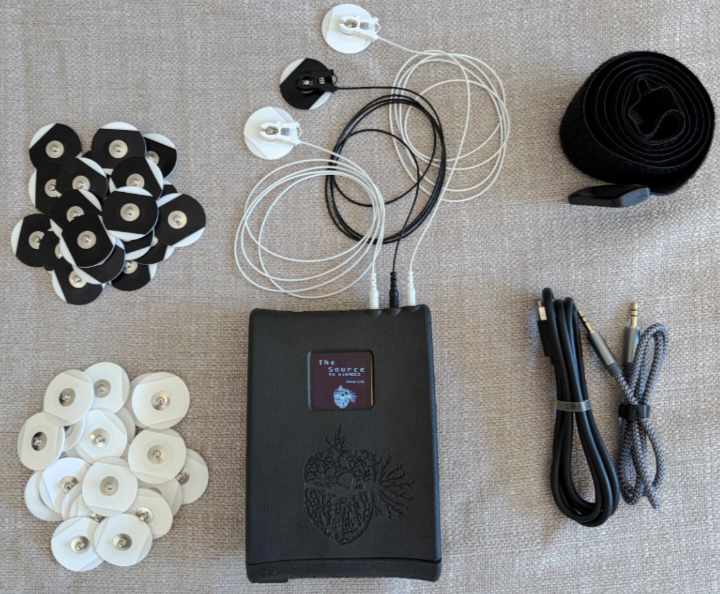
The Source is a wearable device solution for full-spectrum biosensing* that talks to commonly used software platforms for use in the maker and arts communities. Data gathered from The Source is analyzed using our hardware and software tools that interface with popular platforms such as, Arduino, Max/MSP, SuperCollider, Ableton Live, TouchDesigner, and Processing. The basis of the technology is a set of signal processing software tools for the analysis of real-time biophysical signals in real time. The advantage is that the entire analysis system is encapsulated into a set of wearable components, making it much cheaper and less cumbersome to implement in interactive art and performance contexts than in similar systems. The system can be readily combined with additional hardware providing the capability of mapping biophysical signals to experiential, audio/visual media. The tools behind this technology are deployable on many platforms, including software tools that artists and others who are interested in the sonification, visualization, and translation of biophysical data to other media for deployment in performances, installations, and mixed reality environments.
* This includes: electrocardiogram (ECG), electromyogram (EMG), electroencephalogram (EEG), electrooculogram (EOG), electrogastrogram (EGG), ventilatory effort (RSP Effort), electrodermal activity (EDA), pulse plethysmogram (PPG), blood volume (BVP), and blood flow.
bioMECI is:
Ilze Briede
Ilze Briede (artist name Kavi, www.ka-vi.com) is a Latvian–Canadian artist, researcher, and educator. Her practice involves biophysical sensing, creative coding, and immersive media, exploring how physiological data can function as both a material and an agency within artistic systems. She is currently a PhD candidate in the Digital Media program at York University, Toronto, where her research investigates cybernetic systems driven by real-time biopotential signals, including EEG, to develop emergent performative environments. Her work has been presented previously at the International Conference on Live Coding (ICLC 2024&2023), EVA London (2024), Extended Senses and Embodying Technology Symposium (2022), Currents New Media Festival (2021), International Festival of Digital Culture + Code (2021), IASPM Canada Conference (2021), FACTT Trans-disciplinary & Trans-National Festival of Art & Science (2021), SloMoCo (2021), Toronto Nuit Blanche (2019), and Fashion Art Toronto (2017). She holds degrees in Visual and Computational Arts (Canada), Digital Media Production (United Kingdom), and Chinese Language and Cultural Studies (Latvia).
Mark-David Hosale
Mark-David Hosale (www.mdhosale.com, www.ndstudiolab.com) is a computational artist and composer who has given lectures and taught internationally at institutions in Denmark, The Netherlands, Norway, Canada, and the United States. He is an Associate Professor in Computational Arts in the School of the Arts, Media, Performance, and Design, Toronto, Ontario, Canada. His solo and collaborative work has been exhibited internationally at such venues as the SIGGRAPH Art Gallery (2005), International Symposium on Electronic Art (ISEA2006), BlikOpener Festival, Delft, The Netherlands (2010), the Dutch Electronic Art Festival (DEAF2012), Biennale of Sidney (2012), Toronto’s Nuit Blanche (2012), Art Souterrain, Montréal (2013), and a Collateral event at the Venice Biennale (2015), Currents New Media (2017), among others. Mark-David’s work explores the boundaries between the virtual and the physical world. His practice is varied, spanning from performance (music and theatre) to public and gallery-based art. His interdisciplinary practice is often built on collaborations with architects, scientists, and other artists.
Alan Macy
Alan Macy (www.alanmacy.com) is currently the R&D Director and a cofounder of Biopac Systems, a biomedical company. Macy is also the founder of the Santa Barbara Center of Art, Science and Technology (www.sbcast.org), a live/work residency and arts laboratory. Macy designs data collection and analysis systems, used by life science researchers, that help identify the meaning of signals produced by life processes. He has 35+ years of product development experience in human physiological monitoring. His recent research efforts explore ideas of human nervous system extension and the associated influences upon perception. As an applied science artist, he specializes in the creation of cybernated art, interactive sculpture and environments.